T1 Energy (NYSE: TE): The AI Energy Play That Could Make or Break Your Portfolio
T1 Energy is an AI infrastructure play with real growth and serious risks. We break down the numbers, the short seller claims, and the thesis.

When a fund manager with a track record of calling multi-hundred-percent winners takes a 10-million-share position in a company most people have never heard of, it is worth paying attention. That is exactly what happened when Leopold Aschenbrenner, ex-OpenAI researcher turned hedge fund manager running the Situational Awareness LP fund, disclosed a brand new stake in T1 Energy (NYSE: TE) in his Q1 2026 13F filing.
T1 Energy has been on my watchlist for some time. After doing our own independent research, this article is our honest assessment: what the company actually is, what the numbers say, what the serious risks are, and whether the stock still has room to outperform from here at roughly $9.40.
The short answer is that this is one of the more interesting risk/reward setups in the AI infrastructure space right now. But it is also one where getting the risk framing wrong could hurt you badly. Let's get into it.
Why Aschenbrenner's Conviction Matters
Leopold Aschenbrenner made his name not by picking AI stocks broadly, but by identifying where the specific bottlenecks in the AI build-out would appear and investing in those chokepoints before the market caught on. His previous calls include SanDisk (+690% year-to-date) and Bloom Energy (+230% year-to-date). He manages well over $10 billion in assets and the fund is growing fast precisely because of this bottleneck-identification approach.
His Q1 2026 position in T1 Energy, acquired when the stock traded between $5 and $10, reflects a thesis that is straightforward once you lay it out: AI needs compute, compute needs data centers, data centers need electricity and the US does not have enough domestic solar and battery infrastructure to supply it. T1 Energy is trying to be a foundational piece of that supply chain.
That is the hook. Now let's look at what you are actually buying.
What T1 Energy Actually Is
T1 Energy is a US solar module manufacturer headquartered in Austin, Texas. But the company history matters here, because it shapes the risk profile.
Until 2024, the company was called FREYR Battery and the entire investment case was built around constructing battery gigafactories in Norway. That strategy was abandoned. Management terminated the battery technology licensing, exited the Norway manufacturing plans and executed a full pivot: they acquired a 5 gigawatt solar module factory in Texas from Chinese solar giant Trina Solar, moved the headquarters to Austin and rebranded as T1 Energy in February 2025.
This is not the first version of the company. That context matters when assessing management credibility and execution track record.
Today, the business has three pillars:
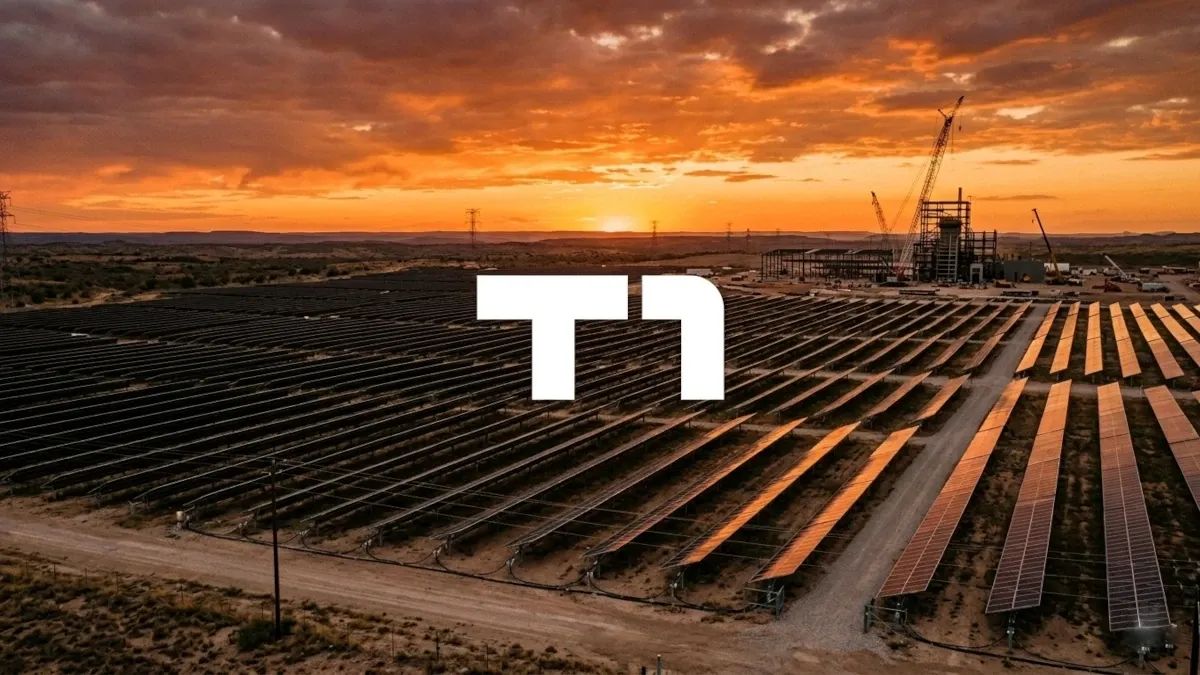
G1 Dallas, the operating asset. A 1.35 million square foot solar module assembly facility with 5 GW annual nameplate capacity, already generating revenue. It buys solar cells from suppliers, assembles them into finished solar panels and sells those modules to utility-scale solar developers and large energy infrastructure companies. This is what is generating T1's revenue today.
G2 Austin, the growth engine. A planned 5 GW solar cell fabrication plant is currently under construction in Milam County, Texas, with an $820 million total cost and first production targeted for Q4 2026. When operational, T1 will produce both the cells and the modules, vertically integrating and dramatically improving margins. This is the pivot point on which the bull case depends.
KORE Power, the battery storage acquisition. Acquired in June 2026 for $32 million, KORE Power is an engineering-focused battery energy storage systems company covering design, installation, software and operations. Solar power without storage is an intermittent asset; adding battery storage capability turns T1 into a more complete energy infrastructure provider. Management expects the acquired business to contribute $15 to $20 million in EBITDA by 2027.
There is also a data center project in Norway, where T1 is converting its legacy industrial site into a 50 MW hydroelectric-powered facility with potential to expand to 396 MW. This is early-stage and speculative, but it shows the breadth of the AI infrastructure angle.
The Revenue Story: Real Growth With Real Caveats
Full-year 2025 revenue came in at $755 million, a dramatic jump from essentially zero the prior year, reflecting the first full year of the Dallas facility operating. In Q1 2026, T1 generated $177 million in net sales, up from $53 million in Q1 2025. On the surface, that is outstanding growth.
Two important caveats.
First, revenue is lumpy. Q3 2025 brought $210 million, Q4 2025 surged to $358 million, and then Q1 2026 dropped back to $177 million, roughly half of the prior quarter. Management attributes this to large customer order timing and solar seasonality, and that explanation is plausible. But it means you cannot extrapolate a single quarter in either direction. The 2026 guidance of 3.1 to 4.2 GW of production would represent up to 50% growth on 2025's 2.79 GW at the high end, but hitting that guidance requires consistent execution at a scale T1 has not yet sustained.
Second and more critically: almost all Q1 2026 revenue was related-party revenue from Trina Solar, the Chinese company from which T1 acquired the Dallas factory. That is a single-customer concentration that would concern any serious investor. The relationship with Trina is also at the heart of the biggest risk factor we need to discuss.
The Section 45X Tax Credit Engine
Understanding T1's economics requires understanding Section 45X of the Inflation Reduction Act, because this is where a large portion of the company's profitability actually comes from.
Section 45X is a production-based tax credit that pays domestic US solar manufacturers directly based on output, 4 cents per watt for solar cells, with additional credits for modules. The credits phase out starting in 2030 and end in 2032. Crucially, under IRA transferability rules, manufacturers can sell these credits to third parties who want to offset their own tax bills, converting the benefit to immediate cash.
T1 executed its first 45X credit sale in December 2025, raising $160 million by selling credits at 91 cents per dollar to an investment-grade buyer, with Citigroup acting as advisor. That single transaction went a long way to improving T1's liquidity position. The company ended 2025 with $270.8 million in cash compared to $76.6 million a year earlier.
When G2 Austin comes online and T1 is producing both cells and modules domestically, the credits stack, you earn a credit on cell production and again on module assembly. Management has guided for $375 to $450 million in Adjusted EBITDA in 2027, a number that is heavily dependent on that stacking mechanism working as expected. That target is aggressive, but it is not a fantasy if execution delivers.
This is also why the FEOC compliance question, which we cover next, is so consequential. The entire economics of the business are built around these tax credits.
The Fuzzy Panda Problem: The Risk You Cannot Ignore
In May 2026, short seller Fuzzy Panda Research published a report that sent T1 shares down sharply and set off a controversy that has not been fully resolved. Any honest analysis of this stock has to engage with it directly.
The core allegations, stripped to their essence:
FEOC non-compliance. T1's tax credit eligibility depends on not being classified as a Foreign Entity of Concern, meaning not being effectively controlled by Chinese interests. Fuzzy Panda alleged that T1's claimed compliance is hollow because the intellectual property transfer from Trina Solar went to a Singapore-based entity called Evervolt, whose owner has longstanding ties to Trina. The report claimed the IP never truly left Chinese control. If this is accurate, T1 could lose an estimated $224 million in 2026 tax credits, swinging operating margins from roughly +6% to -31%.
Accounting concerns. Fuzzy Panda alleged T1 booked $41.4 million in Q1 2026 tax credits it had not yet received, and that this may require restatement. The report also disclosed that T1 had received subpoenas from both the DOJ and the SEC.
G2 construction delays. Drone footage cited by the short seller purportedly showed limited construction progress at the Austin site in early May, with Fuzzy Panda estimating the project is running 12 to 18 months behind schedule.
A follow-up allegation. In a subsequent report, Fuzzy Panda alleged that a whistleblower provided 26 invoices showing T1 purchased more than $65 million in solar cells from Trina Solar in Q1 2026, directly contradicting management's public statements that the company had switched to four non-Chinese, FEOC-compliant suppliers.
T1 management denied the allegations. Roth Capital, one of T1's most vocal bulls with a $10 price target, called the selloff a buying opportunity and defended T1's FEOC compliance status, calling the company "fully transparent." T1 also announced the completion of transactions intended to confirm 2026 tax credit eligibility, with CEO Dan Barcelo stating the company is committed to FEOC-compliant domestic manufacturing.
The stock rallied 28% in a single day on the Roth defense, aided by high short interest above 27% of the float creating a short squeeze dynamic.
Our assessment: the FEOC situation is the single biggest gating risk for this investment. The DOJ and SEC subpoenas are real and publicly disclosed. Roth Capital's defense is plausible and comes from an analyst with deep sector expertise. But the question is not fully resolved, and until it is, the risk cannot be dismissed. This is not the kind of uncertainty that resolves itself quietly; it resolves loudly in one direction or the other.
Balance Sheet: Improved But Not Comfortable
The capital position has improved materially since the dark days of 2024, when T1 had $72.6 million in cash against $507.9 million in long-term debt and a Piotroski F-Score of 2 out of 9. The $440 million capital raise in Q4 2025, combined with the $160 million tax credit sale, transformed the liquidity picture.
As of Q1 2026, T1 ended the quarter with $117.1 million in cash, improved by a $150 million convertible notes offering upsized from $125 million, partly used to repay $45 million of higher-cost debt. Management states the company has sufficient liquidity to operate for at least the next 12 months.
The concern is ongoing dilution. Every capital raise, and T1 has needed frequent ones, adds shares. Shares outstanding grew 11.6% in fiscal year 2024 alone. The G2 Austin factory still requires approximately $220 million in additional funding to complete. Future equity or convertible debt issuances will continue to dilute existing shareholders, which sets a ceiling on how fast the stock can re-rate even if the thesis plays out.
The Macro Tailwind Is Real
Setting aside the company-specific risks, the structural backdrop for what T1 is attempting to do is genuinely strong.
US solar manufacturing capacity has surged beyond 50 GW, driven by IRA incentives and tariffs on Chinese solar products that now reach 145%. A domestic manufacturer like T1 benefits from both sides: Chinese competition is made expensive by tariffs, while Section 45X credits make domestic production more profitable. The US government has signaled that domestic content in solar supply chains is a national priority, with the One Big Beautiful Bill Act provisionally extending 45X credits through 2032.
AI data center construction is driving unprecedented demand for utility-scale power. The largest cloud and hyperscaler operators are signing long-term power purchase agreements at scale and solar plus battery storage is emerging as the fastest-deployable combination to meet that demand. T1's 900 MW offtake deal with Treaty Oak Clean Energy, starting in 2027 and requiring domestic cell content from the G2 Austin facility, is a tangible example of this demand materializing.
First Solar, the clear benchmark in US solar manufacturing, trades at a significant premium to T1. If T1 can execute and clean up its compliance story, a valuation re-rating toward established domestic manufacturers is possible.
Valuation and What Analysts Think
At $9.39 and a market cap of approximately $2.6 billion, T1 trades at a negative P/E (the company is not yet consistently profitable on a GAAP basis), with a trailing price-to-sales ratio that some analysts describe as attractive given the revenue trajectory.
The analyst picture is mixed in an instructive way. Northland initiated with an Outperform rating and a $16 price target in June 2026, representing roughly 70% upside from current levels. Roth Capital maintains a Buy with a $10 target. Bernstein initiated at Market Perform with no specific upside thesis, a cautious but not bearish read. The average price target across six analysts sits around $10.50.
The 52-week range tells the volatility story better than any single figure: $1.15 to $12.49. This stock has been a roughly 10x mover in one year. Anyone considering a position should size accordingly.
The Bottom Line: A High-Stakes Thesis With an Unresolved Risk
T1 Energy is a genuinely interesting company executing a legitimate strategy in a structurally favored sector. The AI energy bottleneck is real. Domestic solar manufacturing with Section 45X support is a durable economic model if the regulatory ground holds. The Aschenbrenner endorsement reflects a serious assessment of where capital constraints in AI infrastructure will bite hardest.
But right now, the FEOC and DOJ/SEC situation is an open wound. Until it resolves and it will, loudly in one direction or the other, it represents a binary risk that any investor needs to weigh carefully against their own risk tolerance and portfolio context. The G2 Austin construction timeline is a second gating factor: Q4 2026 first production is management's target and the short seller's drone footage suggests that timeline deserves scrutiny. The Q2 2026 earnings call on August 7 will be a crucial data point on both fronts.
Here is how we frame the three scenarios, to help you do your own thinking:
Bull case — FEOC compliance confirmed, subpoenas produce nothing material, G2 delivers cells in Q4 2026. Management's $375 to $450 million EBITDA target for 2027 becomes credible. The stock re-rates toward $16 to $20+, representing a potential 2x to 2.5x from current prices.
Base case — The stock consolidates between $8 and $11 through the rest of 2026 while the market waits for concrete execution proof points, with the FEOC uncertainty acting as a ceiling on re-rating.
Bear case — FEOC non-compliance confirmed, tax credits clawed back or denied, G2 delayed 12 to 18 months. The stock revisits the $4 to $6 range, unwinding much of the 2026 run.
The risk/reward here runs sharply in both directions. This is not a situation where the downside is bounded. Investors who are drawn to the macro thesis will need to weigh their own conviction on the FEOC resolution, their comfort with binary regulatory risk, and how a position of this volatility profile fits within their broader portfolio, questions only they can answer, ideally in consultation with a qualified financial advisor.
What is clear is that the August 7 earnings call is a key event. That is when the picture of both FEOC clarity and G2 construction progress gets meaningfully more defined.
This article is for informational and educational purposes only and does not constitute financial advice. Always do your own due diligence before making investment decisions. The author may hold positions in securities mentioned.